

06.08.26
I've started a new company.

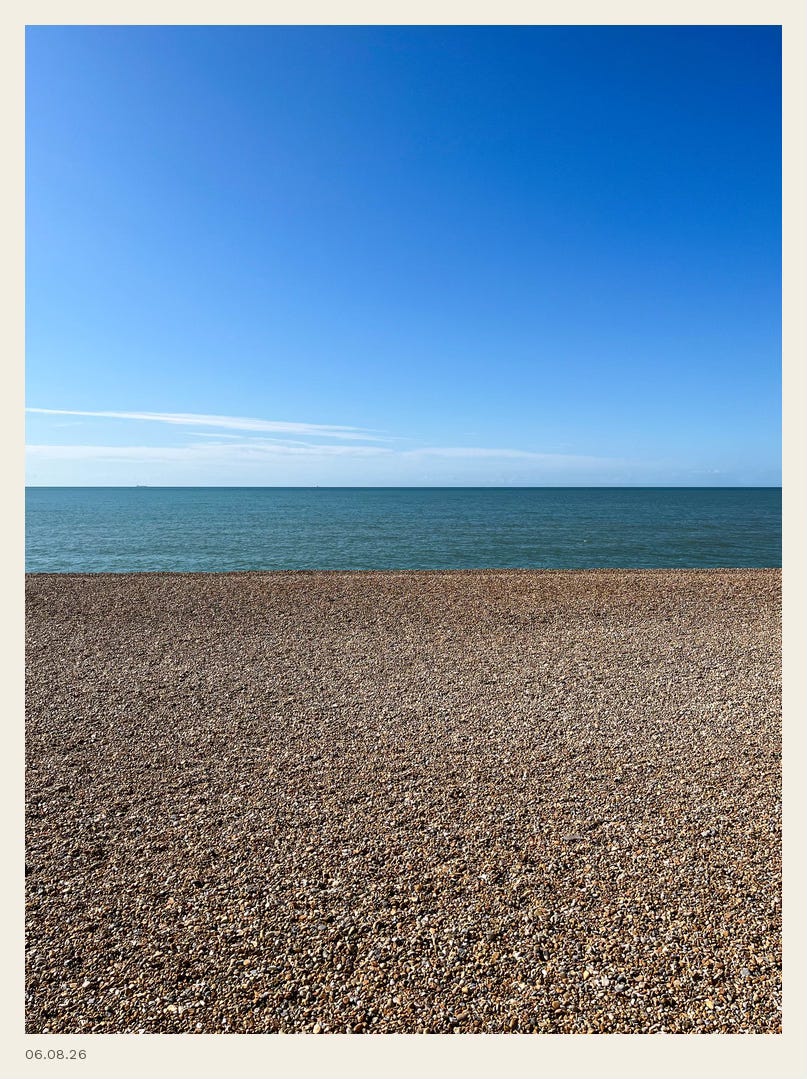
It’s a glorious day. Unanimous sea and sky, clear horizon; it’s the kind of day that makes you feel positive and ready to tackle the world.
One of the matters absent from yesterday’s confessional, is that on Tuesday I had a meeting with my accountant about when to incorporate a new business. I was in two minds about instructing my accountant, because he’s the accountant for my other companies, and I harboured a concern that, should I ever fall into dispute with my other companies (which I don’t expect I would, but never say never), he would be conflicted. He also has a loyalty to those companies. On the other hand, he’s able to look across the whole scope of my business and financial interests, which is an asset. So I chewed on this decision for a while, called one of my closest friends - a lawyer, who always gives excellent advice - ran it past him, and landed on appointing my existing accountant to look after my affairs as I march into my new, independent future.
I had the initial chat, and he advised that I shouldn’t delay incorporating - I’m already spending money on this production, I need to incorporate immediately. So, I have a brand new company, which is the…let me count it up: one, two, three, four, five, six, seven – it’s the seventh for me. Amazing. I founded the longest running one (which is still running as a going concern) in 1999, when I was a teenager. This new one feels just as significant, in its way.
People have been asking me to explain what the new company does, and I can’t really say, which is not a situation I’ve been in before. It exists as a blanket vehicle for all my activities which are currently in film and video, but will shift about into different things. At the present moment, it’s a vehicle for this film, and I can run production expenses through it, which is important.
Setting up a bank account has proved difficult. It’s hard to escape the feeling that the environment in the UK has really sharpened against small business, and particularly new business. It’s easier for me to navigate because of my experience: I was able to field the questions of the bankers, who asked various absurdities, like how much money would arrive from overseas, or how much money would I spend outside the UK over the next twelve months, broken down into exact figures by specific country. I had to explain the elementary – this is a new business, that’s not how it works; it’s insane to ask these kinds of questions. I gave them an answer that I hope they’ll be satisfied with, we’ll see.
The whole process seemed very suspicious, hostile even, there are a lot of barriers being thrown up, many more than when I first started in business. In the late ‘90s, early millennium, the UK was a great place to be, people arrived from all over the world to be part of it. This was at the height of the New Labour, Blair government and London, in particular, was tremendously exciting, one of the most exciting places to be in the world; everyone wanted to be part of it. The arts were thriving, it was a technology centre, it was a cultural centre. It’s sad to see how far we’ve fallen. The UK has become a smaller, more jealous place, it’s lost all of its self-confidence. This is partly attributable to the legacy of the 2008 crash and the financialization of the British economy over the past forty years, we can’t ignore that. All governments, since the Thatcher government from ‘79, have played their part in it and it would be an error to single out just one, but the particular character of the moribund, defeated, exhausted nation that we have now? I pin it squarely on the fourteen years of Conservative government from 2010; it was a disaster for Britain, most especially Brexit, which was their fault and their responsibility.
It was sobering to have the experience of trying to start a new business and finding all of these barriers, which had not existed when I was younger. There’s a seam of political discourse in our media about why British productivity has slowed, why British economic growth has been stagnant for more than a decade, and has fallen so far behind that of the US. This is often a tortured discussion – “Why? Why is this??”. It’s because of this unsympathetic, unconducive environment. There are barriers everywhere, an atmosphere of suspicion, people and institutions don’t seem to want to help startups.
Again, when I first started out, Britain was eager to help its young people to go out into the world, be entrepreneurial, do things, start things. I now get the sense that the precise opposite is true – there are questions, roadblocks, interrogation, suspicion. And a general atmosphere of negativity and pessimism, a reproachful atmosphere, in a way. That’s why our economy is not doing well, it doesn’t require all these tortured discussions to discover the answer: the culture and psychology of our nation needs urgent revision.
I’m hopeful Andy Burnham can do it, but I’m not sure government is, as yet, correctly diagnosing the issue. They’re looking at the spreadsheets, but not the larger, cultural factors, the national consciousness which has taken such a kicking and is badly dented by austerity and the Brexit wars. As Gramsci observed, culture precedes politics.
Anyway, there’s my gratuitous political digression for the day. I have my latest company, and I go back to creating its inaugural work, with positivity, because it’s such a lovely morning.