

20.07.26
Going Solo & efficiency

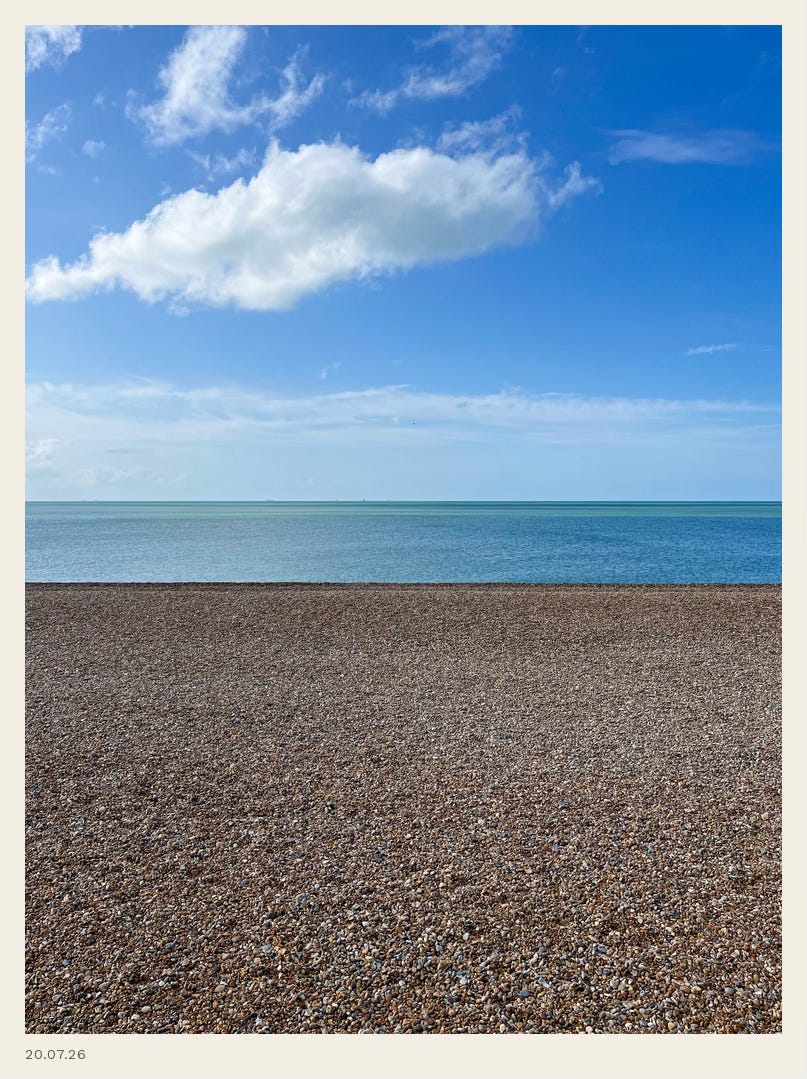
Today is the first day of the school summer holidays. It’s a challenge to maintain my routine, including the morning walk, around the demands of childcare and juggling schedules. Everything has to be negotiated a little bit more. It does mean that I get access to a lie-in, and don’t have to snap out of bed on the school clock, but that’s not something I really want to take advantage of anyway. I do like to rise early and make sure that I get my walk done and my photo taken; maintaining a stable rhythm is more challenging when the kids are around.
I hosted a family birthday party over the weekend, so I was on the barbecue most of Sunday, before sitting down in the evening to watch the World Cup final - Spain emerged victorious, which was excellent news.
It recalled for me the scene in Heat in which Al Pacino asks Robert De Niro, “So you never wanted a regular type life?” De Niro replies, “What’s that? Barbecues and ball games?” Pacino smiles, “Yeah”.
I remember watching that scene when I was fifteen years old, and thinking, “Yeah - who wants the regular type life?” At this stage of life, I fucking love barbecues and ball games.
One thing that this project has highlighted to me, though, is the difficulty of having to do too much. I’m the only person, other than my music collaborator, working on this film, and it’s too much work, basically. It means that I can’t do more than one thing at a time, when ideally the project needs to advance on multiple fronts. As I’ve been pulled back onto chasing archive, everything else is suspended, which makes the process desultory and excessively time-consuming.
This is a problem that accompanies the asset of being multi-skilled. I always prided myself on having multiple skills, and being able to produce, write, direct, edit, and work on several films simultaneously. I was (am) able to complete a feature film project up to and including being able to author the manufacturing master for the commercial DVD. And it’s a huge cost saver - whereas other productions paid a producer, writer, director, and editor to all simultaneously be engaged on the project, with two, sometimes three people in the edit suite every day during post-production, with me, there was always just one. The escalating day-rate bills for all of those people never materialised.
But the flip side is that doing it all yourself can become exhausting and manufacture a false economy as things take longer and deadlines extend. There’s also a danger that it can compromise the quality of the work. A single, coherent vision can improve the quality of the work, but not having another source of creative input, and having to rush or cut corners as the time becomes squeezed can weigh on quality.
I’m trying to keep these lessons in mind as I move towards new commercial activity. The most successful people that I’ve worked with, and the most successful projects that I’ve done, have all systematised the workload and delegated effectively to others; even if that means spending more money than you necessarily have to. Paying someone else for something that you can do yourself may save time and money in the long run, even though it may have a greater up-front cost.
I always felt that we failed to get that balance right at my former company. We often calculated that it was quicker for us, the company directors, to do the work ourselves, rather than train, and delegate to, others. But I think that ethic prevented us from establishing proper systems, part of which is accepting that maybe the job is not going to be done as well as you think it would be done if you did it yourself.
It’s needs must for this project, but going forward I’m conscious that I will have to do things differently. As I make this film, I am trying to think about process as a solo operator, and how I can learn and establish processes that I develop from here. That’s going to be a part of my decision-making around what I do next: I have to be able to set up systems and processes, fail fast, and be able to delegate as quickly as possible. I’m asking those questions as the film progresses: what am I doing that could be delegated? What am I doing that could be set up as a process or system? Accomplishing systems for revenue will allow me to focus my own energies on my core creative work. When I look back over the past twenty-five years, I can see that I would have had much greater space for my own creativity had I been more consistent about designing and maintaining good systems for everything else.